
Every summer it seems to happen.
Temperatures climb, reservoirs fall, and another hosepipe ban makes the headlines. For many people, it’s an inconvenience. For businesses, it’s easy to dismiss as something that doesn’t really affect them.
But recurring hosepipe bans are worth paying attention to—not because they stop people watering their gardens, but because they are an early warning sign of a much bigger challenge.
The question isn’t whether we’ll see another hosepipe ban next summer. The question is what happens when these become a regular feature of life in the UK.
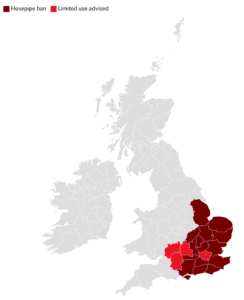
Hosepipe ban map | Independent
A Hosepipe Ban Isn’t the Problem
Water companies introduce Temporary Use Bans (hosepipe bans) to reduce demand during periods of prolonged dry weather. Restricting non-essential household use helps preserve supplies while keeping water flowing to homes, hospitals and businesses.
In isolation, they’re a sensible short-term measure.
The concern is that we’re seeing them more frequently.
Hotter summers, changing rainfall patterns, population growth and ageing infrastructure are all placing greater pressure on the UK’s water network. While winter rainfall can still be significant, longer dry spells mean reservoirs and groundwater don’t always recover as quickly as they once did.
The result is a system with less resilience.
Water Is Becoming a Business Risk
Most businesses won’t be directly affected by a hosepipe ban today.
But water scarcity doesn’t begin when taps run dry—it begins when reliability becomes less certain.
For organisations that depend on water, whether for manufacturing, food production, hospitality, healthcare or construction, even modest restrictions can create operational challenges.
Businesses may face:
- Rising water costs as investment in infrastructure increases.
- Greater scrutiny of water consumption.
- Pressure to improve efficiency and reduce waste.
- Potential restrictions during prolonged droughts.
- Supply chain disruption as suppliers face their own water challenges.
Just as energy security has become a board-level discussion over the past few years, water security is steadily moving in the same direction.
The Hidden Cost of Water Scarcity
Water doesn’t need to disappear for businesses to feel the impact.
Imagine a food manufacturer whose suppliers experience irrigation restrictions. Crop yields fall, raw material prices rise, and production costs increase throughout the supply chain.
Or consider a manufacturer that relies heavily on water for cooling or cleaning. If drought measures limit abstraction or increase operational costs, production becomes more expensive.
The knock-on effects are felt far beyond the businesses directly using large volumes of water.
Water scarcity becomes an economic issue rather than simply an environmental one.
Investing in Resilience
Addressing water scarcity will require significant investment.
Across the UK we’re already seeing plans for:
- New reservoirs.
- Water recycling schemes.
- Smarter water networks.
- Leakage reduction programmes.
- Interconnected regional supply networks.
- Greater use of digital monitoring and analytics.
These investments improve resilience, but they also come at a cost that will inevitably be reflected in future water bills.
For businesses, understanding and managing water use is becoming increasingly important—not just from a sustainability perspective, but from a financial one.
What Businesses Can Do Today
The organisations best prepared for the future won’t necessarily be those using the least water—they’ll be the ones that understand it.
That means:
- Monitoring consumption across sites.
- Identifying hidden leaks and inefficiencies.
- Benchmarking usage against similar organisations.
- Reviewing tariffs and supply arrangements.
- Investing in water efficiency where it delivers measurable returns.
Small improvements made today can reduce costs and improve resilience tomorrow.
Looking Beyond the Headlines
A hosepipe ban is visible. Water scarcity is gradual.
One makes the news for a few weeks; the other has the potential to reshape how businesses think about one of their most fundamental resources. As climate pressures continue and demand grows, water will increasingly be viewed in the same way organisations now think about energy: something to monitor, optimise and manage strategically.
For businesses, the message is simple.
Don’t wait until water becomes a problem. Start treating it as a resource worth managing today.